
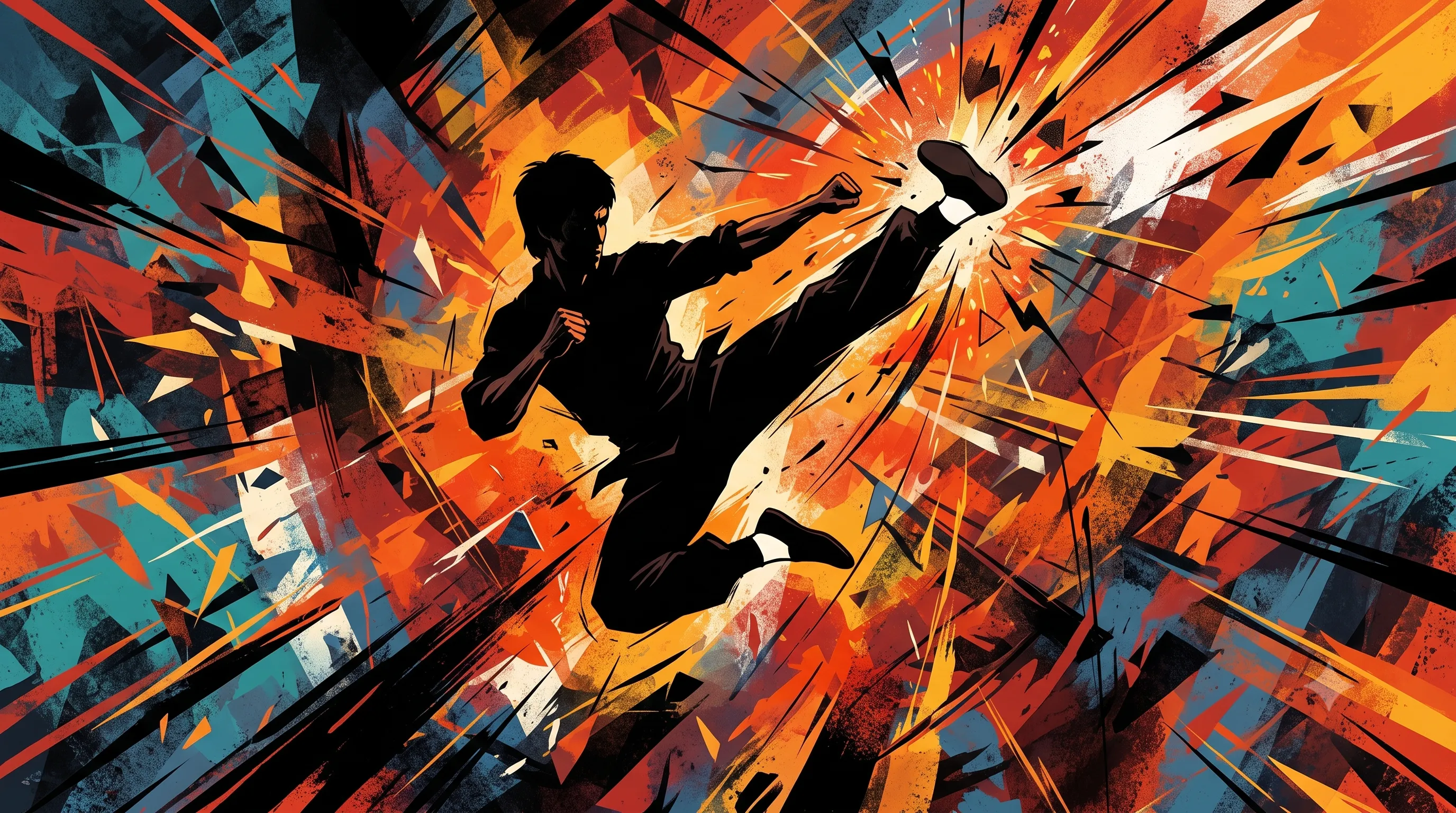
What We Talk About When We Talk About Bruce Lee
I recently spent an entire afternoon watching YouTube reels of Bruce Lee performing martial arts. All of those videos seemed to follow the same format, showing vintage-styled footage of him with a voiceover saying something spiritual, such as “be like water.” It was fascinating in the moment.
Only once the time had fully passed, and I’d watched what felt like endless short videos, did I realize most of them were completely AI-generated.
When I asked Google Gemini about this, it gave me the typical “You’re not crazy” response, assuring me that it was becoming a pretty common tactic on YouTube these days to create such videos and waste the time of otherwise totally employed and productive people like me, for views and dollars.
But a simple question kept looping in my brain.
Why? Why Bruce Lee?
AI can generate anything, but whoever created those videos deliberately chose Bruce Lee as the subject. And it worked!
There was definitely something in those videos that resonated with me on a base level, even though I had never really seen a Bruce Lee movie before writing this article. In fact, I really don’t know anything about Bruce Lee other than what those videos seemed to be encapsulating; this is someone who knows how to kick really fast and talk really well, and it’s motivational and inspiring.
So, one has to wonder, how did the whole “Bruce Lee as warrior-monk” image/meme originate, and how much of it was true?
Who was Bruce Lee (the actual man), and who was the meme? And why does the idea of him still exist in the cultural zeitgeist today, and why does it still land so hard?
So I started researching and figuring this out for myself, and I did not expect the rabbit hole to be this deep.
Bruce Lee as a philosopher in the strict sense of the word
From a strictly academic perspective, Bruce Lee is not considered a philosopher. He never wrote an academic paper and was never recognized in that field beyond serving as a subject or reference.
According to his biography “The Bruce Lee Story,” he was sent to live with his sister in San Francisco because he beat up the kid of a feared triad family in a rooftop fight, and his family was scared for him. He would then move to Seattle, work as a live-in waiter, and later start teaching martial arts on the side while completing high school. Bruce Lee attended the University of Washington, and it is often cited that he “studied philosophy” there. While he did take philosophy classes, his actual major was in drama. [1]
Eventually, he would drop out of college to pursue a career in acting and filmmaking.
Given this background, it is fair not to consider him as a philosopher in the technical sense of the word. However, the world would be a pretty boring place if only academics could have thoughts about life.
If we stretch the definition of philosophy to include people who are masters of a particular field and have really sharp, original insights, then it is plausible to consider Bruce Lee a philosopher (in the same way one would consider Eminem a philosopher).
In many cases, it is better to see such things as art rather than actual philosophy in the strict sense of the word. Sometimes, that line is blurred when we talk about Bruce Lee.
Art and philosophy
A simple, largely all-encompassing definition of art is something that can be performed or experienced, and that triggers a certain emotion, thought, or feeling in the audience. For example, a horror movie seeks to trigger fear in you; a love song seeks to evoke an emotional, loving feeling in you; a public awareness campaign seeks to prompt thoughts about a particular issue; and so on.
Additionally, art usually involves some method and practice. For example, a filmmaker needs to understand cinematography, scriptwriting, and editing, while a painter needs to learn about color, composition, and the painting process.
I also believe that literally almost anything can be art. For example, see Marcel Duchamp’s Fountain [2]. But philosophy cannot be about just anything.
To me, the objective of philosophy is usually not to evoke emotions or feelings (though it can) but to generate ideas and concepts with a purpose. Every serious idea should stand the scrutiny and be capable of being logically wrestled with, if not fully resolved. One might consider this a purely “Western” point of view, but even Eastern philosophical concepts follow logic and stand up to scrutiny, even if they take a different approach from simply writing papers.
What I’m trying to say is that there is a difference between actual Daoist teachings and bumper stickers, even though they might look the same on the surface.
Yes, Bruce Lee does fit the aesthetics of a warrior-monk philosopher (largely made up by vested corporate interests), but we must judge the validity of him being that based on the ideas, not the man. One of his most popular ideas was Jeet Kune Do.
Jeet Kune Do, or the way of the intercepting fist
Of course, Bruce Lee had developed his own proprietary fighting system.
Instead of following the rigid technical standards most martial arts demanded, he developed a style based purely on pragmatism.
The famous “be like water” quote is a direct reference to this system. His point, within this particular context, was to be extremely flexible and not get lost within the mythology and aesthetics of the practice. Take what is useful and disregard what is not. Of course, this is a simplification, and he also had many thoughts on the mechanics of fighting and other specific ideas in that domain, which remain highly relevant to martial arts today.
The style would eventually be known as Jeet Kune Do or “the way of the intercepting fist.” Other maxims include a focus on balance and using motion effectively, and things like striking the enemy while the enemy is striking you (emphasis on the intercepting part). However, the important thing is that Bruce Lee never claimed this was a specific style.
“I have not invented a “new style,” composite, modified or otherwise that is set within distinct form as apart from “this” method or “that” method.” - Bruce Lee [3]
What Bruce Lee was teaching through his technique was to stop focusing on dogma and to avoid being tied to a single way of fighting. Instead, the student should seek to learn as many techniques as possible, develop their own style of the system, and avoid falling victim to ideology. Later in life, Bruce Lee would come to regard this method as a philosophy of life as well, in some aspects, but unfortunately, he did not live long enough to fulfill that objective.
The book “The Tao of Jeet Kune Do” was published in 1975 after his death. Bruce Lee did not write that book. The bulk of the content was found in notes he scribbled while recovering from a back injury that left him unable to practice. Almost all of it was scribbled in a single session. Other source material includes notes he kept on his fighting style.
He did want to write a book, but not one on philosophy or life in general. He wanted to write a specific book on martial arts and his approach to the art.
“If you want to learn to swim jump into the water. On dry land no frame of mind is ever going to help you.” - Bruce Lee [4]
Ultimately, the book, as it ended up, was published posthumously after being edited by several editors granted access and permission by his widow. It is one of the most cited books when we talk about his philosophy today.
However, it can be disingenuous to claim that Bruce Lee fully authored the book and intended it to be released in that manner. Yes, they were his notes, but viewed and presented through others’ lenses.
It is likely that the whole thing was more of a marketing gimmick, which elevated his passing interest in philosophy to something mysterious, as if he had actual answers to all questions about life when he just had very interesting answers to the questions about fighting and filmmaking.
Yes, you can take his quotes and apply them to another domain and claim it fits, but that does not mean your interpretation is aligned with the speaker’s intentions by default. In my opinion, this is highly exploitative and would only get worse.
What happened after his death is also more proof that the whole idea of Bruce Lee as it exists today is completely alienated from the actual man who passed away too soon in an unexpected, tragic turn of events.
Brucesploitation: The man, the myth, and the clones
On July 20, 1973, the martial arts world came to a devastating and abrupt halt. At just 32 years old, Bruce Lee died unexpectedly in Hong Kong. The news shocked his fans and colleagues alike, seemingly defying reality given his legendary strength, intense training regimen, and undeniable vitality.
Hong Kong’s movie industry went into a panic after the sudden passing, as he had become a massive international star with the release of Enter the Dragon in 1973.
They had found the pitch-perfect formula to break into the Western market, and they just lost the jewel and the guy who effectively made all this happen. The world had gotten a taste of Bruce Lee, and they wanted more and expected Hong Kong to deliver. This was right in the middle of the “Kung Fu Fever” the US was going through in the 1970s.
Hong Kong’s film industry was not going to let this go away so easily. So they went looking for replacements who could maintain the image Bruce Lee had set. Yet, the way they chose to do it seems very weird by today’s standards.
Instead of trying to find the next Bruce Lee, they went literally looking for people who resembled Bruce Lee and could convince the English-speaking world they were seeing the real thing.
This would lead to a genre of movies that are now classified as brucesploitation. Yes, they did it so many times that it’s now considered a subgenre; that’s how popular martial arts were during that time!
The Clones of Bruce Lee (1980), released seven years after his death, is one of the most well-known in the genre. The plot centers on three clones of Bruce Lee who fight various villains throughout the movie. The clones were played by famous actors who had made a name playing Bruce Lee or Bruce Lee-type characters in Brucesploitation movies.
In a way, that mimics what actually happened in real life as well. It seemed to have started with a certain innocence. Initially, the movies were about Bruce Lee’s life in general, and it was natural for another actor to play him. But over time, this would devolve into absurdity as producers tested what they could get away with.
Producers would also take considerable liberties in framing the plots of movies about his life, often changing details and trying to project an image of him, sometimes omitting parts of his life, including his time in the US.
One of the first movies in the genre was Super Dragon: The Bruce Lee Story (1974), which starred an actor and martial artist called Bruce Li (this was not his real name but rather a stage name used on the posters for international markets quite intentionally). [5]
Born as Ho Chung-tao, Bruce Li would go on to have a decent career playing Bruce Lee in several movies.
He was chosen because not only did he look like Bruce Lee, but he also moved and did martial arts like him on screen. Bruce Li was a massive fan of Bruce Lee and had essentially studied him; it is also fairly evident from his quotes from the Enter the Clones of Bruce Lee documentary that he never shared the producers’ dry, greed-driven cynicism and always maintained that he could never be Bruce, only act like Bruce, be a clone of him.
And he was not alone.
There was also Bruce Le, Bruce Ly, Brute Lee, Bruce Lai, Bruce Lei, Bruce Liang, Bruce Thai, and Lee Bruce, to name a few.
Over time, producers would attempt to squeeze every bit of Lee they could, leading to weird titles like the 1975 movie Bruce Lee Against Superman and to a subgenre of movies that acknowledged Bruce Lee’s death. In those movies, he returns from the dead to complete a mission, and he is played by one of the clones.
One of the weirdest and most blatant examples of this subgenre is the movie Game of Death (1978). Bruce Lee was in the middle of shooting the movie when he died, leaving the producers in a unique dilemma. The digital techniques back then were not good enough to deepfake him, so they resorted to practical effects.
Bruce Lee wrote the original script and shot some footage, intending to direct the entire movie after he finished Enter the Dragon. After his death, another director took over the project and built a completely new story from whatever footage remained of the original shoot.
The original plot of the movie centered on a martial artist fighting various enemies in a fairly abstract setting. It was based on the idea that you could adapt to different fighting styles, since each enemy would have a specific one, and he would have to fight each of them differently. The footage he shot before his death was mainly of some of these fights, which the eventually released film would feature.
But the new director had to change things, and he, by today’s standards, made some weird choices. He changed Bruce Lee’s character to become a movie star named Billy. They picked the movie-star character because they also had behind-the-scenes footage of Bruce Lee, and if Billy were a movie star, those shots could be used.
The plot goes that Billy is becoming a big movie star, so naturally, gangsters threaten him. He then has to fake his death, undergo plastic surgery, and take revenge on them. Of course, all the gangsters are made up, and the final fight scenes that Bruce Lee shot were repurposed in a way where each of the enemies (different styles of martial arts) became one of the gangsters he had to fight.
The funny thing is that even though the Bruce Lee we see on screen for most of the movie is played by people who are not Bruce Lee, the movie still credits the entire role to Bruce Lee and proudly markets it as such.
It is a bit jarring to watch that movie because once you start looking closely, it becomes very clear that the person is not Bruce Lee. They would always try to hide it by using camera angles, making the character wear sunglasses for many scenes, basically doing anything to mask the fact that it’s not Bruce Lee.
While the clones tried their best, they had the impossible job of being a dude playing a dude playing another dude.
The quality of a Bruce Lee fight scene (like the famous fight scene at the end of The Way of the Dragon) is almost comically superior to what the clones did. The clones were also expert martial artists, but they were not Bruce Lee, and it clearly shows that once you recognize the unique fighting style the original had. But that did not stop them.
These movies were often marketed internationally in a way that implied they were the real Bruce Lee. Some would put him on the poster front and center, but only add a few seconds of actual Bruce Lee footage in a movie that doesn’t really have anything to do with him or his character.
To the untrained eye (which is almost everyone when it comes to esoteric martial arts), there is very little difference between Bruce Lee and the clones on film.
At this point, it might be fair to ask. What the heck? Why were they milking it this hard?
Why couldn’t they just let go of Bruce Lee?
Bruce Lee: the man, the myth, and the meme
Bruce Lee was not the first person to do martial arts on camera, even in the US. In fact, Frank Sinatra actually uses karate in “The Manchurian Candidate” (1962). However, Bruce Lee was the first to present martial arts in cinema as we know and take for granted today.
His breakout appearance before an international audience was in the television series The Green Hornet. He got the role of the show’s sidekick, Kato, because someone connected to the show’s producers saw him perform at a demonstration and was blown away by his impressive techniques, such as two-finger push-ups and the one-inch punch.
Bruce Lee fully dedicated himself to the role, took acting classes, and worked on how his presence would look on camera.
Instead of using guns or the typical boxing-style brawls common on TV at the time, he would use actual martial arts on screen, based on the techniques he was developing (which would later become Jeet Kune Do). There is a story that, initially, his movements were so fast that 24-frames-per-second cameras couldn’t keep up, so he had to slow them down. [6]
He would also influence the story and the character himself, elevating the role from a sidekick to essentially the star of the show. When the show was set to collaborate with The Batman TV series at the time, Kato was supposed to lose to Robin, but he completely refused the idea and forced the story to be changed. [7]
Despite his undeniable charisma and scene-stealing abilities on television, Hollywood remained deeply prejudiced and hesitant to cast him as a leading protagonist at that time. Frustrated by the lack of meaningful roles and after famously being passed over for the lead in the TV series Kung Fu, Lee returned to Hong Kong in 1971.
He quickly discovered that The Green Hornet had been a massive hit there, informally dubbed “The Kato Show” by locals, which gave him the perfect leverage to sign a film contract with the newly formed Golden Harvest studio.
His first starring role in The Big Boss (1971) smashed box office records across Asia, proving that his magnetic on-screen presence and ferocious, realistic choreography could easily carry a film.
He followed this with an even bigger domestic success, Fist of Fury (1972), and soon took complete creative control by writing, directing, and starring in The Way of the Dragon (1972). In just a couple of years, Lee transformed from a marginalized Hollywood supporting actor into the undisputed king of Asian cinema.
This unprecedented, record-breaking success across the Pacific finally forced Hollywood executives to pay attention, leading to a historic collaboration that would change action cinema forever.
Warner Bros. approached Lee and Golden Harvest to produce Enter the Dragon (1973), marking the first-ever martial arts co-production between a major American studio and a Hong Kong company. The film was custom-built to introduce his martial arts philosophy, staggering athleticism, and intense screen presence to a mainstream Western audience.
Released just one month after his tragic passing, Enter the Dragon became a colossal global blockbuster. It ignited the massive “Kung Fu Craze” that swept through the United States in the 1970s, firmly cementing Bruce Lee as a permanent, mythical fixture in global pop culture.
In May 1973, just months before his death, three imported Hong Kong martial arts films simultaneously held the top three spots at the US box office. [8]
Enter the Dragon, a film produced on a meager $850,000 budget that would go on to gross an estimated $400 million worldwide across multiple releases, making it one of the most profitable movies in history. [9]
Lee had single-handedly built a bridge between Eastern action and Western audiences, sparking a ravenous global demand for his specific brand of lightning-fast choreography and anti-establishment swagger. When he died right at the apex of this gold rush, he left behind an insatiable worldwide audience and a massive financial vacuum.
So, the decision to “clone” him was not just about homage or respect but rather sheer capitalistic necessity. One can argue it worked commercially, but most Brucesploitation films are not regarded with the same critical acclaim as the original movies, which were truly groundbreaking for their fight scenes.
Cloning Bruce Lee in the Age of AI
Coming back to the AI-generated YouTube reels of Bruce Lee with all this context, it kind of makes sense now why they chose his image as the subject. What the creators of those reels are doing is basically what the movie industry had already done for a long time. And it works particularly well for how AI generates content.
Bruce Lee’s image has been cloned so many times throughout history that it has become bigger and, to a certain degree, detached from the man himself. The AI could get a few details wrong, but it doesn’t matter since there are so many actual filmed variations of his image that most people cannot tell the legit Lee from imitations anyway.
As long as the AI captures the basic vibe of Bruce Lee and produces a somewhat respectable artifact based on it, it is inseparable in form from what the studios were doing back in the 70s. It is the real fake Bruce Lee.
But there is a bigger and far more interesting question after that. Why does it work? There are two levels to this.
First, why was the original Bruce Lee, the man himself, so appealing to audiences to gather a following in the first place?
The original Bruce Lee appealed to audiences because he was authentic and unique. Instead of using camera tricks or effects, he would actually perform expert-level techniques live on camera at blistering speed.
Imagine all your life you’ve seen movie fights as a slow sequence of punches: you see the punch thrown, then the reaction in a different cut, then the second punch in the next, and so on. Then this guy comes along and beats up six men at once and stays in focus on camera the entire time doing it. It was an authentic display of controlled righteous violence with immense dedication. He did to martial arts what George Lucas and Steven Spielberg have done to special effects in cinema.
This type of on-camera fighting originated with Bruce Lee, continued through the likes of Jackie Chan and Jet Li, and still influences movies like the John Wick series, where the focus is often on extremely tight fighting scenes with fast choreography. The techniques are much more advanced, and shots are much more impressive, but that style of filmmaking has its heritage in movies like Enter the Dragon.
He was also a massive personality outside of cinema and martial arts. Instead of accepting his fate as a sidekick or secondary, he would go on to break barriers, destroy stereotypes, and become an iconoclast. He would master his own body and fuse different rigid martial arts into one unified, fluid fighting style, which he practiced and perfected every day.
But why do we think of him first as a mysterious philosopher rather than as the actual person he was? Why do we admire him for the one-inch punch rather than for his contributions to cinema that made it possible for future Asian leading men to develop their own styles in Hollywood?
The answer is actually not that complicated, and in some regards, even that malicious.
For a symbol or a meme to work, you need to compress the original three-dimensional entity into a flat, two-dimensional one so it is easily shareable. But in this compression, you will always lose details and often the essence of the thing, rendering the two-dimensional version almost a different thing in reality.
The French philosopher Jean Baudrillard actually had a name for this exact kind of societal flattening: the simulacrum.
In his book Simulacra and Simulation, he argued that modern society replaces genuine reality with endless, mass-produced symbols that eventually lose all connection to the original source. Bruce Lee’s transformation from a living, breathing martial artist into a mystical bumper-sticker philosopher is the perfect example of this.
Over decades of cinematic cloning and pop-culture repetition, the meme has completely overwritten the actual man in our collective memory. We are now just looking at a hollow simulation, a copy of a copy that feels authentic only because we are so used to seeing it.
You can get Bruce Lee clones to imitate him, but they can never be who he was, and the image of Bruce Lee can never come close to Bruce Lee, the three-dimensional man (just like Game of Death will never come close to Enter the Dragon). But it doesn’t matter since the idea of Bruce Lee had already overtaken reality.
And when you throw AI video generation into the mix, it becomes an extremely low-resolution copy of that. In this case, it worked because it is extremely hard to tell the low-resolution copy from the first copy done over forty years ago.
The image of Bruce Lee and why it appeals to people
If the image of Bruce Lee and Bruce Lee (the person) differ, but both appeal to people, it is fair to question whether they do so for the same reason. And I think the answer is no, they do not appeal to people for the same reason.
The two-dimensional image of Bruce Lee is rarely about martial arts or filmmaking. It’s about life or using his quotes and applying them in a context he never meant. This is what the producers did with Brucesploitation, and this is what the AI did with those reels. Bruce Lee wanted his films to demonstrate his approach to martial arts and his constantly evolving personal vision. Still, the producers wanted them to show a Bruce frozen in time, making him rigid rather than the flexible, fluid being he actually was. They rendered a visionary into a stuntman and a prop.
And it’s not a niche, small thing that is limited to just martial arts or YouTube. It is a cultural meme, the Richard Dawkins definition of the word, and that’s why it has such staying power. For example, look at this BMW ad that uses Bruce Lee talking about how his fighting style is to be adaptable rather than follow fixed procedures, and they just spam their car next to it like “yeah, what he said.” They’re using his symbol as a car dealership’s signboard, which is just as absurd. [10]
Another reason I think the image persists and resonates in today’s world is that it provides an escape fantasy from modern office-worker and capitalist life and, at the same time, a power fantasy that convinces you you’ll be able to kick like Bruce Lee if you could just figure out how to be like water.
But it’s a false image.
It ignores the fact that he routinely punched buckets of sharp gravel and thrust his hands into hot sand just to calcify and deaden the nerves in his knuckles physically, or that he had a custom 300-pound heavy bag built specifically for him because he would routinely tear standard canvas bags in half with a single kick, or that he hooked his own muscles up to an electrical stimulation machine to force violent muscle contractions, pushing his body past its natural nervous system limits.
He had to do more than wax philosophical about being water to do the things he did on screen. But the reel ignores all that and makes it seem as though the two are connected. It creates an easy dopamine hit in your brain because, for a few seconds, you feel the answers to things are clear. You would rather not question this for a bit and give in to the fantasy, because reality is much more nuanced and cannot provide a clear dopamine hit as a 2D artifact can.
Societal compression and memes
Even though I spent the entire afternoon watching those videos and my brain did feel rewarded, it was for nothing substantial, really. I learned nothing, just interacted with the two-dimensional edges of an infinitely richer three-dimensional object.
By contrast, researching this article was hard. I had initially wanted to write a take-down of Bruce Lee’s philosophy and how it’s just bumper stickers with no substance, and how AI is exploiting that.
But I realized that AI was generating content based on an image of Bruce Lee, which was already a copy of the original, stripped of most of its meaningful substance.
My respect for him grew the more I researched him. I sat through most of the movies mentioned in this article. I have spent over two weeks on this article by now. And my brain still feels the same reward those reels delivered, but it feels earned and more permanent. God pity the person who casually references Bruce Lee to me.
It’s also worth noting that this societal compression is not unique to Bruce Lee. There are many other examples where nuanced characters become social caricatures, like Che Guevara’s face on t-shirts in malls across the world. Or Marcus Aurelius, who spent most of his life fighting massive wars for the Roman empire, becoming a “bro-stoic” podcast reference used to sell self-help books, trivializing his insights and stripping away all nuance.
This trivialization reflects what Theodor Adorno and Max Horkheimer famously dubbed the “culture industry.”
They argued that modern capitalism treats popular culture like a massive factory, intentionally stripping away any dangerous nuance or genuine struggle from a subject to mass-produce safe, standardized goods.
Instead of asking audiences to engage with the complex reality of a historical figure, this system repackages their identity into a predictable, easily digestible formula.
It pacifies the public by offering the illusion of deep philosophical engagement while actually just feeding them pre-packaged, dopamine-hitting soundbites. Ultimately, this machinery transforms messy, authentic human reality into a slick product designed purely for endless commercial exploitation.
We seek these symbols because they are easy to read and easy to sell. It is hard to sell the idea of an ambitious man who pushed his body to the limits and was a truly great martial artist without elevating him to a warrior-monk status. If we make the secret “be like water” rather than “break your body until you master it,” it becomes more marketable because it’s easier to digest.
Lastly, it wouldn’t be unfair to say that Bruce Lee also played a part in generating this unique image of himself, because he knew it would sell easily to international markets.
He was a smart, nuanced man who understood Hollywood as well. It is easier for us to accept that this is just a mysterious eastern warrior-monk man who can kick really fast and has vague, wise things to say that we can vibe to without thinking much about what he’s actually saying or caring about his real legacy. So the next time an AI-generated Bruce Lee pops up on my feed telling me to ‘be like water,’ I’ll know I’m not looking at a philosopher, a master, or even a man. I’m just looking at a ghost in the machine.
References:
- U. of Washington alumni records
- Fountain (Duchamp)
- Jeet Kune Do Concepts
- https://www.goodreads.com
- Jackie Chan tried to replace Bruce Lee… | SMCP
- How the speed of Bruce Lee forced directors… | faroutmagazine.co.uk
- Why Bruce Lee Once Refused To Lose… | screenrant.com
- 1973: When kung fu ruled the American box office | thechinaproject.com
- Obsession becomes highest-grossing film… | CBC
- https://www.youtube.com/watch?v=RXwJACmAchg