
Why David Levinson Could Hack Aliens Using a PowerBook 5300 in Independence Day (1996)
Disclaimer: Major spoilers for Independence Day (1996) in case the title doesn’t imply it strongly enough.
In the movie Independence Day (1996), Earth is invaded by technologically advanced aliens that just want to destroy everything in their path. They are like an invasive species, but on a cosmic level, with the singular goal of stripping the resources of any civilizations in their path. They have no desire to negotiate with lowly humans and would prefer eradication to any form of negotiation, setting up the film’s main conflict as humans gear up for war.
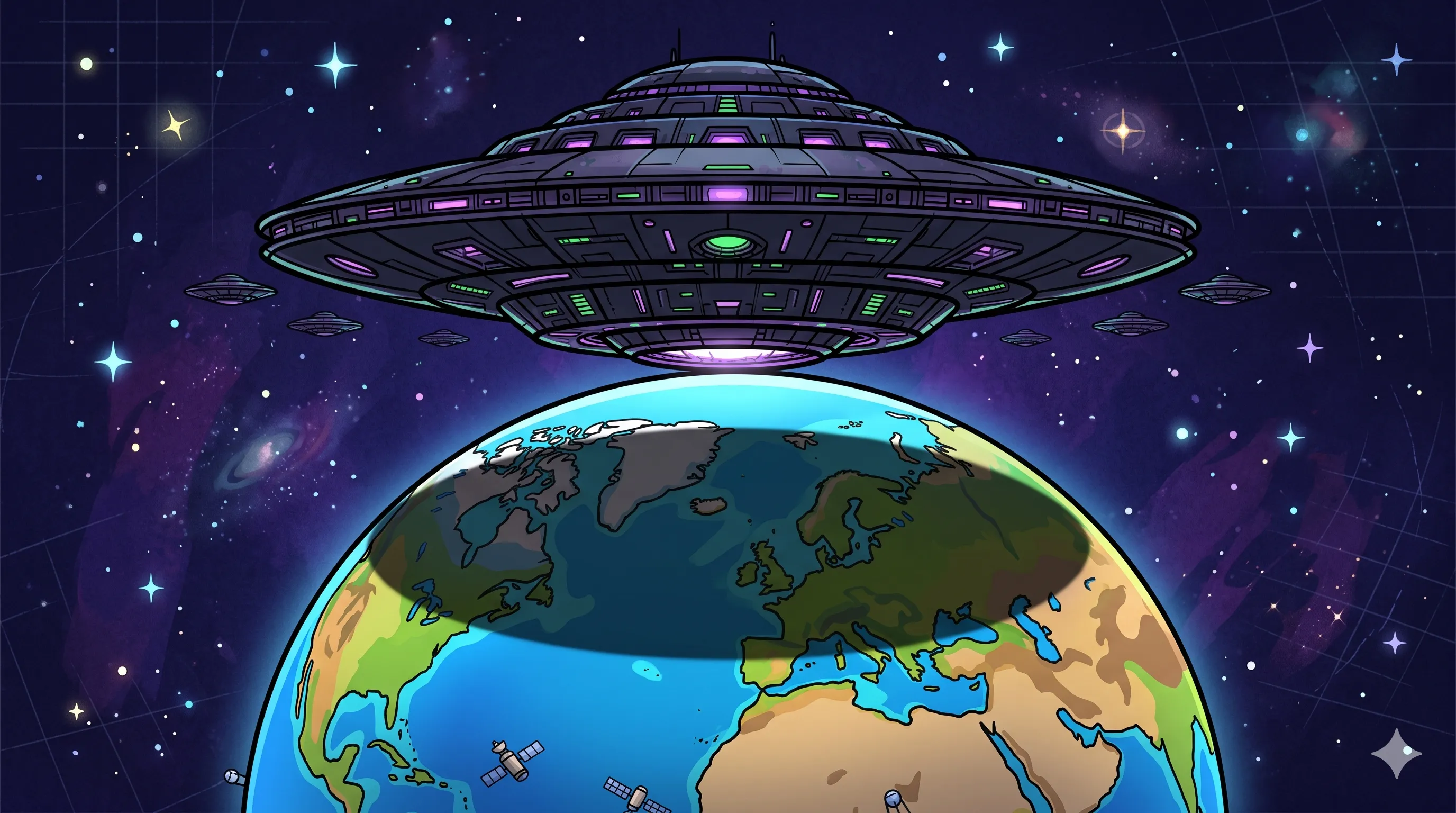
The first scene introduces us to the saucer-shaped spaceships slowly making their way towards our planet. These ships would then strategically position themselves across the planet. They plan to blast really powerful laser-type beams capable of destroying an entire city, and they intend to coordinate their attack using our satellites.
We follow the story from many points of view (in fact, they introduce almost too many characters in the first act), but the main protagonists of the movie are Capt. Steven Miller, a USAF pilot played by Will Smith, and David Levinson, a Jeff Goldblum-type character played by Jeff Goldblum.
Levinson is a TV satellite technician who happens to be one of the first people in the world to figure out that the alien signal is essentially a timer for all those ships to coordinate their attack.
For this article, we’re going to hyper-focus on David’s point of view and one particular scene near the end of the movie. This scene is one of the most important, and perhaps most discussed, in the movie.
The setup is simple: our main heroes are aboard a refurbished alien aircraft that crashed on Earth long ago, and they fly it into space, managing to sneak aboard the mothership, with the aliens none the wiser.
Then they dock with the central command of the mothership, and David uses his freaking Apple PowerBook 5300 to deliver a computer virus to the ship’s system, which disables its shields and sends an OTA update to all the spaceships, bricking their shields as well. This enables humans to attack the aliens with conventional weapons and a lot of cheesy one-liners, culminating in a cigar-smoking celebration of the world being saved.
But for now, let’s go back to that particular scene. Depending on how much you know about computer science, you could have different interpretations of the scene.
If you don’t care about computers at all, what happened on screen seems kind of feasible (it’s all computers, right). If you know a little bit about computer science, you might think it’s just plain stupid because how could a human laptop interact with an alien spaceship’s firmware, which is totally valid.
But if you also happen to be a movie nerd who spends too much time reading about things, you’ll realize that not only is the scene kind of feasible, but that it absolutely is, and the filmmakers actually thought about it!
The Issue with Hacking Alien Technology with an Apple Laptop
The main problem with the scene is that it looks ridiculous on its own.
Given the ubiquity of technology today, one might reasonably assume that it shouldn’t be possible for an Apple device to communicate with alien technology - like they’ll probably have different operating systems, or something, right?
And yes, this is largely true.
There is no way the aliens were running Macintosh in their evil spaceships, so it is fair to ask, how could this scene ever happen in real life?
However, if you know more than a wee bit about technology, you might even point out how difficult interoperability [1] is in modern software, and the idea of a Mac-to-alien-stuff driver seems like a ridiculous notion.
However, this is where your engineering mind is stalling you.
Independence Day is a ridiculous movie: Will Smith punches an alien in the face at one point, the US president delivers the best Independence Day speech, then gets into a fighter jet himself to attack one of the big alien laser-beam-shooting ships, and Area 51 is real.
Of course, someone hacking an alien mothership is not crazy within the confines of this already-ridiculous universe.
But what’s really interesting is that the movie actually has an elaborate backstory that explicitly explains why that particular scene works perfectly and is 100% logical.
And this is why you’ll have a different view of the scene if you’re not just a computer nerd but also a movie nerd.
Alien Lore in the Independence Day Universe
As (more casually than deserved) stated before in this article, Area 51 is real in the movie. And the Roswell crash actually happened. An actual alien craft crashed on our planet, and the US government recovered the craft and has been studying it for decades.
And this top-secret research, which would reverse-engineer the spaceship’s technology, would directly lead to the inventions that we take for granted as the bedrock of all modern computer systems. So, in the movie’s universe, microchips and fiber optics are not completely noble human inventions but rather inventions that were derived from studying alien technology.
This effectively means that the underlying technology is the same for humans and aliens in the movie. While their computers did not use Macintosh, they were indeed based on a binary code architecture, meaning it is theoretically possible to write code in a human language, such as C, compile it into binary, and have it be compatible with alien systems!
In effect, this also explains why the aliens were able to use the same signals humans use for transmission and communication (e.g., our satellites for the initial countdown). One of the deleted scenes in the movies actually shows David plugging his laptop into the spaceship at Area 51, interacting with it, and explicitly declaring to everyone that their underlying system architecture is the same as human systems!
Including that deleted scene would have made the virus scene make much more sense, but I could see why the filmmakers decided not to include it. It is not as spectacular as punching an alien right in the face and then screaming at it.
The Problem with a Hivemind Approach to IT
Let’s get even more pedantic now: what if they had a binary-code architecture? That would still not explain why the spaceship would just allow arbitrary code execution for such a sensitive system, right?
Except, guess what, the movie kind of has an answer for that as well.
As mentioned at the start of this article, the aliens are a hivemind species that just want to take over the universe and drill into planets. For them, there is no individual, like a group of ants. And that leads to a fundamentally different approach to technology.
The aliens do not use individual terminals or devices to connect to the internet: they are the internet itself and use the tech to augment their communication and coordination. For the aliens, the spaceships and their exoskeletons are a part of themselves.
This is fundamentally different from how humans see technology. For us, the smartphone is a device that lets us connect to things. For them, they are already connected telepathically and are just using computers to extend that ability on a massive scale.
But the fundamental problem is that this network doesn’t have a trust issue. There are no advisories in a hivemind; all of them follow a stream of orders and always have the same objective and thoughts. The fact that one of them would upload something malicious to their version of the internet is not a thought that would even occur to them. Why would you destroy the hivemind?
And this was their weak spot that David Levinson exploited with his virus. And this is why that particular scene in that movie not only makes sense 100% but also points to something very interesting about the philosophy of technology itself.
Edit log
- 25th June 2026: changed to “interoperability” from inoperability