
3 Hypothetical Paintings and Why AI-Generated Art Can Feel Soulless
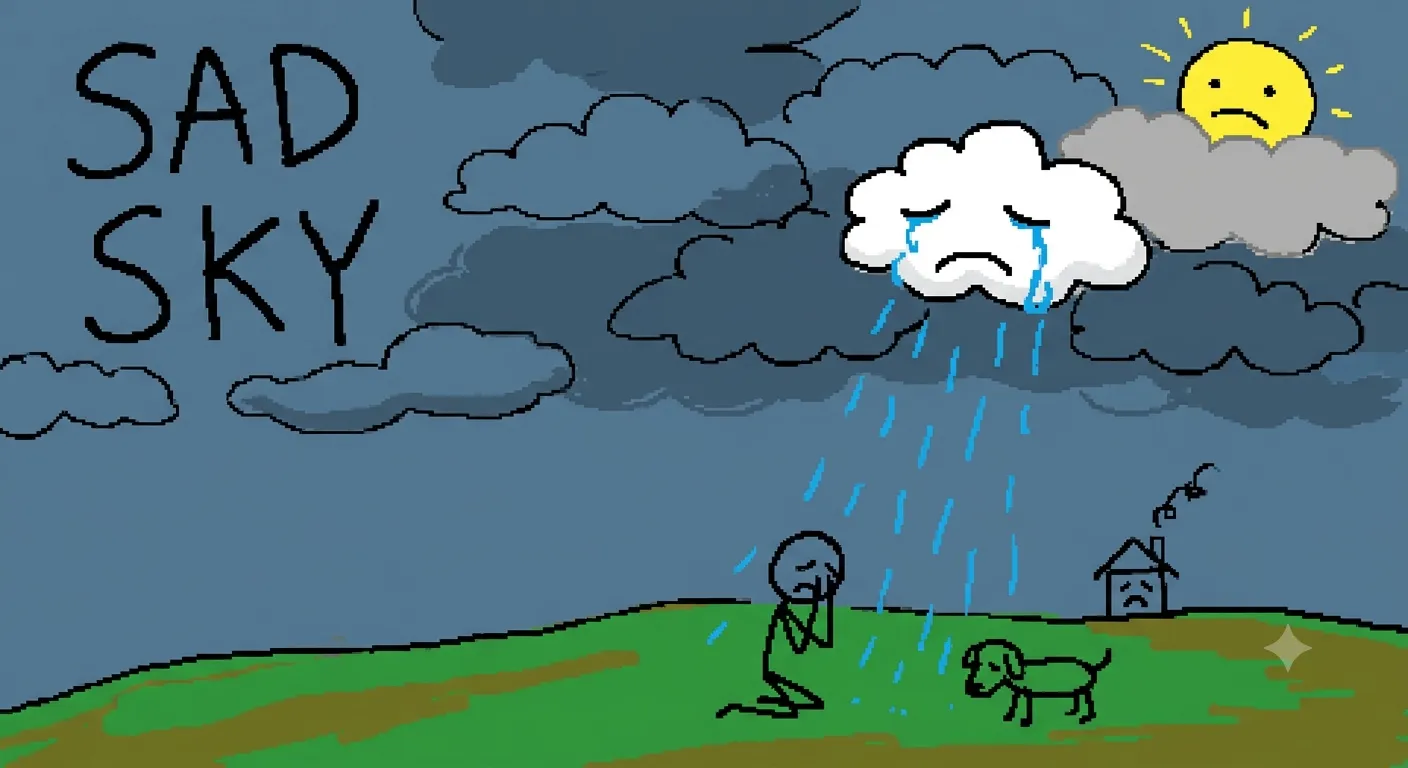
Imagine three identical-looking paintings on a wall next to each other, and under each painting is a small note revealing its origin. The first one, “Sad Sky”, is an original painting by a very famous artist, made in 1902, and it led to the creation of a new style of painting. The second, “Sad Sky Copy”, is a copy of the original made by a student who studied under the artist in 1912. The last one, “Sad Sky AI”, is a perfect replication of “Sad Sky” made using an LLM. If you had to guess the price of each painting, how would you rank them from most expensive to least expensive?
For many people, the ranking will likely be: Sad Sky, Sad Sky Copy, then Sad Sky AI. For some reason, this feels like the right order, and we have seen several examples in the art world that reinforce this order.
But why does this particular order seem intuitive? If all paintings are physically identical, we should value them at the same price, assuming that artistic value completely depends on the physical properties of the artwork. But most art theories suggest that we value art not only on its perceptual properties but also on non-perceptual properties (which are strongly anchored to human authorship in some form).
Because so much of art history has assumed human authorship, it makes sense that the value systems we developed for it generally place heavy emphasis on the artist and the context of the creative process behind the artwork. With AI-generated art, the metrics we have taken for granted suddenly become complicated. This issue can also lead some to dismiss AI-generated art as not art at all. This also points to a more complex argument than the “AI art is bad art” one for explaining why it can feel soulless.
Because even if the AI-generated art is extremely good in terms of perceptual properties, the non-perceptual properties are not as clearly identified or attributable as they are in the case of human authorship. This can lead to a feeling that there is seemingly no (human) artist at all, and hence methods for artistic valuation also face a significant problem that does not really depend on the “quality” of the artwork itself.
If we don’t value human artwork purely by the perceptual characteristics, how can we react to a new form of art that just produces those perceptual characteristics of an artwork?
How We Value Human Art
If the value of an artwork is distributed into its perceptual and non-perceptual properties, what are those properties and why are they valued? Several theories of art have attempted to answer this question, none perhaps fully.
Historical value
One reason “Sad Sky” is likely more valuable than the other two is that it is historically important. The artwork connects directly to a legendary artist, a specific time, and an entire art style. When we evaluate a painting’s value, we consider not only how it looks but also what it represents. This applies to both financial and subjective valuation. For example, the subjective experience of looking at an original Van Gogh painting also includes the value one gets simply from the fact that they’re looking at something that was touched by the artist himself, something in space and time that connects them to a particular person and moment in time, embodying a history in itself since its inception; would this feeling exists in a copy painting made by an university student or an AI replica?
AI-generated art may be valued less because its history is often less immediately legible than that of a human-made artwork. Rather than seeing the artwork as the culmination of a creative process, audiences can see it as though it appeared out of thin air. This effect can lead it to feel like AI-generated art has no history or process behind it, and as a second-degree effect, it might even feel like there is no effort behind it.
This can also be a bit unfair, because it is possible to put in a lot of effort into creating AI-generated art as well, depending on one’s workflow, but the point is that it doesn’t matter how much effort in reality was spent as long as the relationship between the effort and the artifact remains opaque to the audience.
Scarcity
Another reason why “Sad Sky” is likely to be more valuable than the other two is that it is literally the single object in its category. For “Sad Sky Copy”, while that particular copy painting might be constrained by scarcity (made by a particular artist in a particular time), the category does not lend itself to scarcity because one would assume another copy can be created as well by another similarly motivated artist or student. This is where AI-generated art can be seen as having the least value, because the common perception is that the creative process driving it is not bounded by human constraints; in theory, it is possible to generate an infinite number of copies. AI-generated art also exists mostly in the digital realm where the concepts of scarcity don’t map as neatly.
Intentionality
Finally, another reason “Sad Sky” is likely more valuable is that it shows a high level of visible intention from the artist, since our fictional biography mentions that it led to a new style of painting. This assumes the artist exercised a very high level of intentionality in giving the artwork its particular shape. This intentionality is not a static process (i.e., “I will paint this painting in a new style”) but a continuous process in which each micro-decision the artist makes becomes part of the overall intention. “Sad Sky Copy” also shows a similar level of intention, in that the copy artist wants to imitate that painting style and ensure his artwork looks identical to the original, but this intuitively feels less pure than the first case where every intentional decision made by the copy artist is effectively aiming to recapture the original intention of the artist. This particularly hurts AI-generated art from a valuation standpoint.
If the audience thinks the AI-generated art just popped into existence from a prompt, it suggests an extremely low sense of intention from the “artist.” Meaning, if you just prompt a machine and it makes all the minute macro-decisions, most of the intention doesn’t come from you. The machine infers it from data, so we cannot consider it a conscious-driven process, which is what we normally associate intention mainly with.
Again, the lack of intention might not even be true in reality; for example, a counterargument could be that an artist works with an AI tool over several days and intentionally creates an artwork made with AI, driven purely by their artistic process. This could be valuable if the artist can demonstrate their intentionality to the audience, but for most AI-generated art, that is usually not the case.