
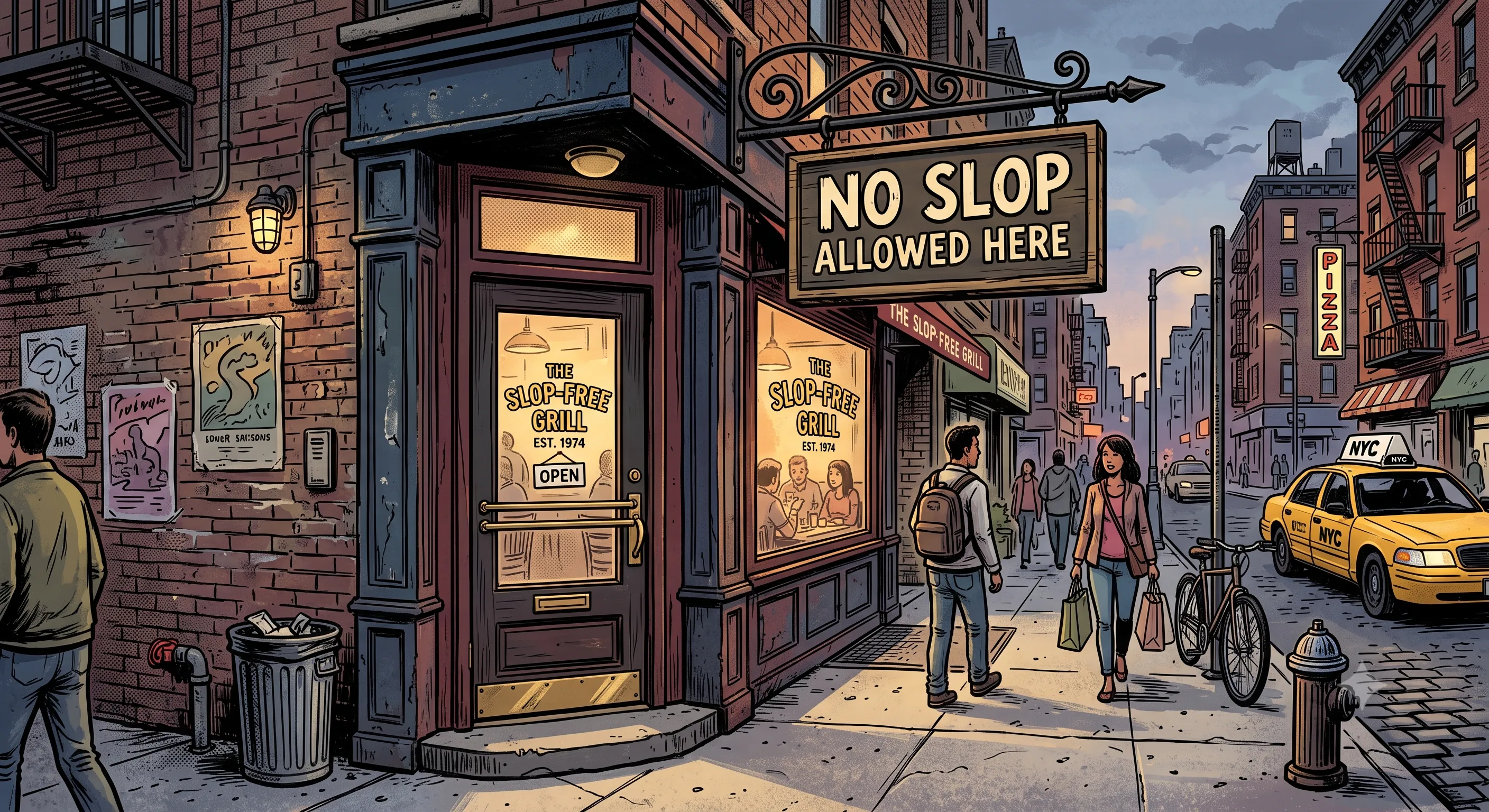
"Aura" and the Backlash Against the Slop Machine
Last month, LinkedIn introduced a new feature which now allows any user to report any public post on the platform as “AI slop.” The decision itself is a pretty strong stance in the sense that it accepts AI-generated content is low-quality and should be reported as slop, but how they frame the option is also interesting. It does not say “report low-quality post” or “seems like bad writing”, it uses the term “AI slop” directly.
This is in sharp contrast to what Microsoft CEO Satya Nadella wrote in his December 2025 blog titled “Looking Ahead to 2026”:
We need to get beyond the arguments of slop vs sophistication and develop a new equilibrium in terms of our “theory of the mind” that accounts for humans being equipped with these new cognitive amplifier tools as we relate to each other.
A lot of people considered that to be him saying that we shouldn’t just use “slop” as a derogatory term for any AI-generated content. A more charitable reading of the same blog could argue that what he’s saying hints at a different insight touching upon how ethical use of AI is important and how we must go beyond debating the quality of AI-generated things and rather reshape how we fundamentally relate to each other since AI is going to profoundly change everything.
In either case, a “seems like AI slop” button is a vindictive slap on the face to both views.
Codeberg and Vibecoding
Another big story of a platform taking a partially moral stance against AI-generated things in July involves Codeberg (a community-based non-profit alternative to GitHub), who recently voted to prohibit “vibe-coded projects”.
On its official blog, Codeberg offers several explanations for their logic behind the vote and the decision. If one goes through the blog, we can mainly point to two categories of problems with vibe-coded projects, namely:
- Ideological issues with using LLMs to code.
- Practical, infrastructure-based issues due to the side effects of vibe-coding.
Using LLMs to work with your code gives you a kick of adrenaline. You can develop at a rapid pace, build things as if you had a large team. Only that you have none. In fact, you are (often) alone, working with a statistical machine that turns energy into code.
- Codeberg blog, “Protecting our FLOSS commons from LLMs” 23rd July, 2026
Codeberg’s stance on both training LLMs on the open-source code hosted on its platform and using LLMs to generate code is pretty clear in that they do not like it. Along with listing the environmental impacts of AI (damage due to excess stress on the digital and physical infrastructure layer), they also raise objections to the practice of “single-use software from scratch”.
Although often well intentioned, sharing the result of an prompt and calling it “libre software” does not make the world a better place. Codeberg is not and does not want to be a place to dump such generated single-use software that no one else will ever look at. We are a place for people to collaborate and improve software together. Within this context, the recent votes can be understood as a reconfirmation of those principles: As we want to center on human collaboration, we will not actively support or engage in the creation of LLMs and will not put our limited resources to use for storing single-use software that would pollute our FLOSS commons.
- Codeberg blog, “Protecting our FLOSS commons from LLMs” 23rd July, 2026
Naturally, there have been mixed reactions since it was announced. Some praise Codeberg for taking a strong stance on vibecoding while others have concerns.
The point I’m trying to demonstrate is that this is very similar to the LinkedIn “seems like AI slop” button except in this case, the slop was not only causing a quality issue for the platform but also hogging its resources (unfairly from the perspective of the platform).
Hank Green Witch Hunt and YouTube on AI, Spotify’s “Unregulated Slop”
A major YouTube personality is also facing a lot of “pushback” over his use of artificial intelligence in his videos in recent days. Hank Green, brother of author John Green and a major driving force behind several popular channels, was accused of using AI-written content in a video.
While the title of the video is “Does Hank Green Shave His Butt? | Soupytime Asks Hank Anything”, linked here, the creator slipped a very weird phrase when answering a question to the effect of “And I appreciate the pushback.” Viewers immediately pointed out that it seemed like an AI-generated answer that he was reading verbatim. This evolved into something bigger as the creator then posted a series of apologies/justifications for his actions, which seemed to have only made the situation worse.
To help keep viewers informed about the content that they’re viewing, we require creators to disclose if AI was used to edit or generate realistic content in their videos. Labels for photorealistic and meaningfully altered AI content may appear on the video player for Shorts or directly below the video for long-form videos. For other types of AI content, the label will appear in the video’s description (e.g., minor edits like beauty filters or animated characters). If a creator doesn’t disclose their use of AI but our systems detect it, we may automatically apply a label.
I have been watching Hank Green’s content since I was a teenager, and I personally do not care if he uses AI as part of his content creation process. In fact, he has openly talked about using AI for coding and doing several other things. That doesn’t personally change my opinion of him as a creator (although I don’t watch his content regularly anymore since the last couple of years).
The backlash against him for this does point to the same issue we’re seeing with people disliking the use of AI-generated things. YouTube’s official policy also mandates the disclosure of AI usage and the degree of use, along with the clause that they are at liberty to force a disclosure if it is not adequately provided, i.e., an automated “seems like AI slop” button.
Even when platforms are supporting AI-generated music, they make an attempt to distance themselves from the “slop”.
Alex Norström, CEO of Spotify, told the Financial Times the streamer was trying to offer a “controlled” alternative, in which musicians can consent to use of their work and make money from it, as opposed to having it pirated. “There’s a lot of rogue attempts at this,” he added… Spotify’s feature will cost extra money, and allow “one song to become 10,000”
"Slop” Labels and Reviewing the Concept of “Aura” in 2026
In his famous 1935 essay, “The Work of Art in the Age of Mechanical Reproduction”, German philosopher Walter Benjamin ponders on what happens to our relationship with art when it can be produced and distributed in mass. At the time it was written, new technologies like film and photography were the trending topics of the day, sparking fears that they would destroy the sacred world of art with cheap imitations. While there are a lot of concepts discussed in the essay, one of the central ideas was that truly original works of art have a quality he referred to as its “aura”. He then argues that the “aura” of a real work of art is tied to its “ritualistic value” as opposed to its “exhibition value”. When it was really hard to create works of art, they were guarded and treated much more sacredly but when it becomes very easy to create/reproduce works of art, the value reverses and the priority becomes virality rather than value.
One might look at the trend of creating Studio Ghibli-inspired images using ChatGPT in recent memory. While the original movies had a ritualistic value to them (a group of animation filmmakers in Japan wanting to push what animated movies mean with amazing, high-quality media), the ChatGPT reproductions did not have any ritualistic value but only a massive exhibition one (where the intention is mainly to show something to other people). This example is a stretched version of the original context sure but it highlights that intentions and resistance are very important when it comes to the value of the art being created. In this context, the main problem with AI slop is that it lacks any intention or resistance that a real human would face and any art trying to copy the original without having a similar level of hyper-specific intention or the natural resistance that one must overcome is likely not to have much “aura”. Audiences/consumers might find this lack of “aura” to be a sign of low-quality.
…for the first time in world history, mechanical reproduction emancipates the work of art from its parasitical dependence on ritual. To an ever greater degree the work of art reproduced becomes the work of art designed for reproducibility. From a photographic negative, for example, one can make any number of prints; to ask for the “authentic” print makes no sense. But the instant the criterion of authenticity ceases to be applicable to artistic production, the total function of art is reversed.
It is easy to draw parallels between what the essay talks about and the current media landscape with artificial intelligence, doing what photography did to painting. While the comparisons are not strictly applicable (after all, photography works fundamentally differently than a large language model) but the question of what is “aura” in the digital age is an interesting one and which largely applies to this topic.
A possible argument one can make is that there is no “aura” in media anymore in today’s landscape and everything is a copy of a copy (I recently explored this concept slightly with Bruce Lee’s image in modern culture), especially with internet culture predominating. For example, it is not possible to differentiate between an “original” YouTube video and a “reproduced one” just by the artifact itself, since both are essentially just binary data and can be perfect clones of each other. In this sense, it is hard to project a sense of “aura” on to the works of arts themselves. Yet, when we look at the attempts to classify AI slop, it can make sense from the point of view of the platforms defending their “aura”.
For example, if Codeberg prides itself in being home to some of the most innovative and excellent open source projects, it is the platform’s “aura”. Similarly, if LinkedIn wants to project itself as the place where industry leaders discuss amazing business ideas, it is their “aura”. AI slop directly threatens their aura by filling their platform with low-effort reproduced art. While many see this as a judgement on the quality of AI work itself, I think it reveals a deeper truth, the onslaught of artifacts in masses by a new form of mechanical reproduction machine is literally stealing the “aura” of platforms that were built over years and in some cases decades.
In this context, even if LLM-generated content continues to get better at a rapid pace, one must wonder if the priority for the platforms will be to protect what makes them worthwhile by double down on categorization or embrace a new (sad to some) relationship with content, code, and art? Furthermore, will such categorization lead to the development of a potential human premium?